
Minimum Safe Abandonment Depth (MSAD)
The minimum safe abandonment depth (MSAD) is the depth above which the cap rock is not strong enough to withstand the pressure from the reservoir fluids.
Generally, the first 500 m of sediment drilled is very soft and unconsolidated.
Lean Decom trainingof good cement, or one 200 ft combination barrier, is the UK guideline for the barriers set below the MSAD.
NSTA, citing the OEUK guidelines (UK example)is the depth at or below which injected CO2 is in a dense supercritical state. For a CO2 store, the MSAD is calculated with a CO2 gradient.
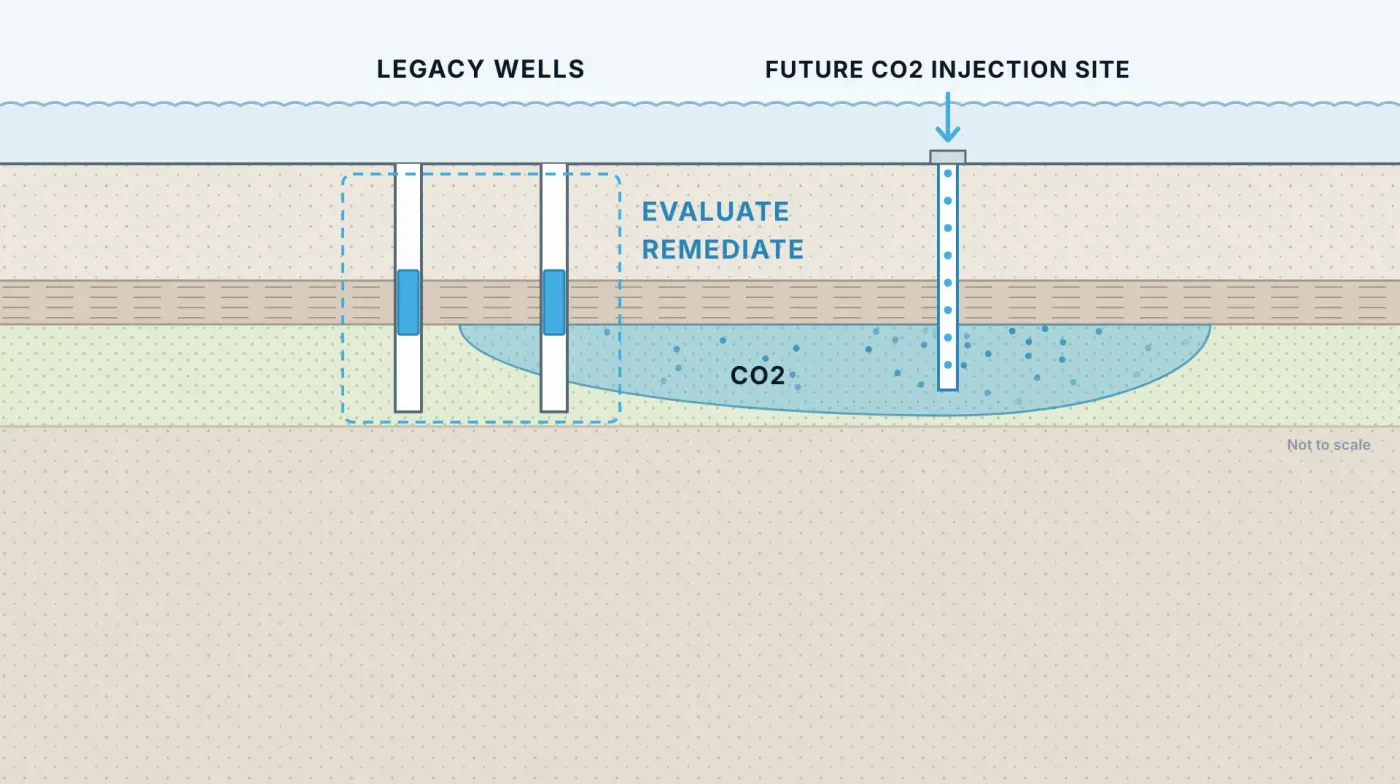
IPCC Special Report on Carbon Dioxide Capture and Storage, 2005Barriers that suited hydrocarbons at the time of abandonment may not be compliant for CO2. The MSAD is also considered for legacy wells.
NSTA, Legacy Wells and Carbon Storage, 2025What is the minimum safe abandonment depth (MSAD)?
The minimum safe abandonment depth (MSAD) is the depth above which the cap rock is not strong enough to withstand the pressure exerted by the reservoir fluids. Above the MSAD, the formation would break down and an abandonment barrier would be ineffective. MSAD is a key output of the subsurface basis of design for abandonment, and the barriers that isolate a zone are set below the MSAD for that zone.
Where this applies: The pressure check behind the MSAD applies to wells in any region. The term MSAD and the worked examples come from the training, where the case material is from the North Sea. Other countries have their own regulator, rules and terms.
Key points
- MSAD stands for minimum safe abandonment depth.
- The MSAD is found on a PP/FG plot: pore pressure and fracture gradient against depth.
- The MSAD is the depth where the reservoir fluid gradient line meets the formation breakdown pressure of the rock.
- The barriers for a zone are set below the MSAD, in an isolation window of suitable cap rock.
- A well can have more than one MSAD. The example well in the training has two.
- For a carbon dioxide (CO2) store, the MSAD is calculated with a CO2 gradient from the maximum reservoir pressure.
What does MSAD mean in well abandonment?
MSAD stands for minimum safe abandonment depth. Two modules of the training use the term: one for well plug and abandonment (P&A), and one for wells in carbon capture and storage (CCS).
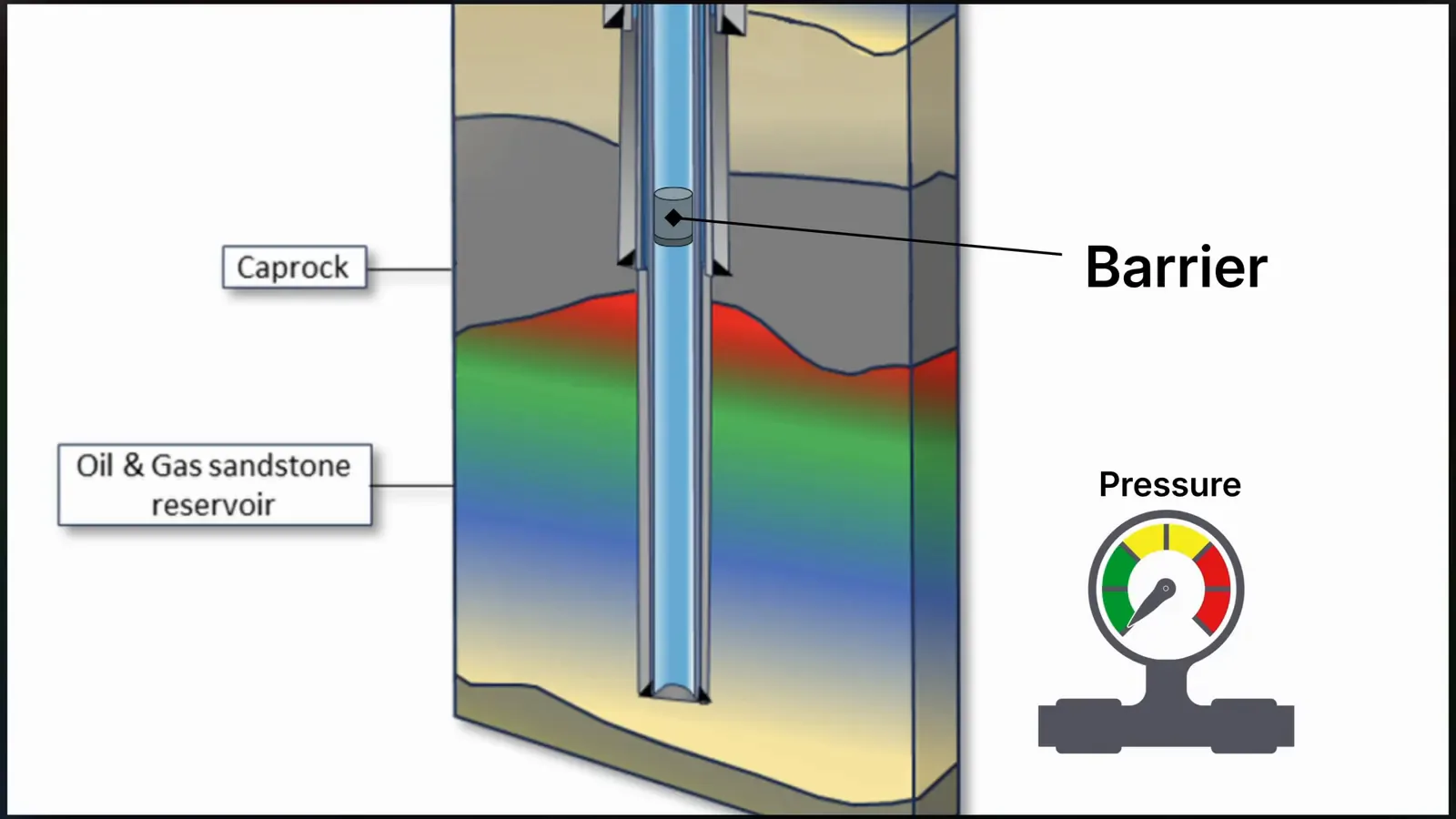
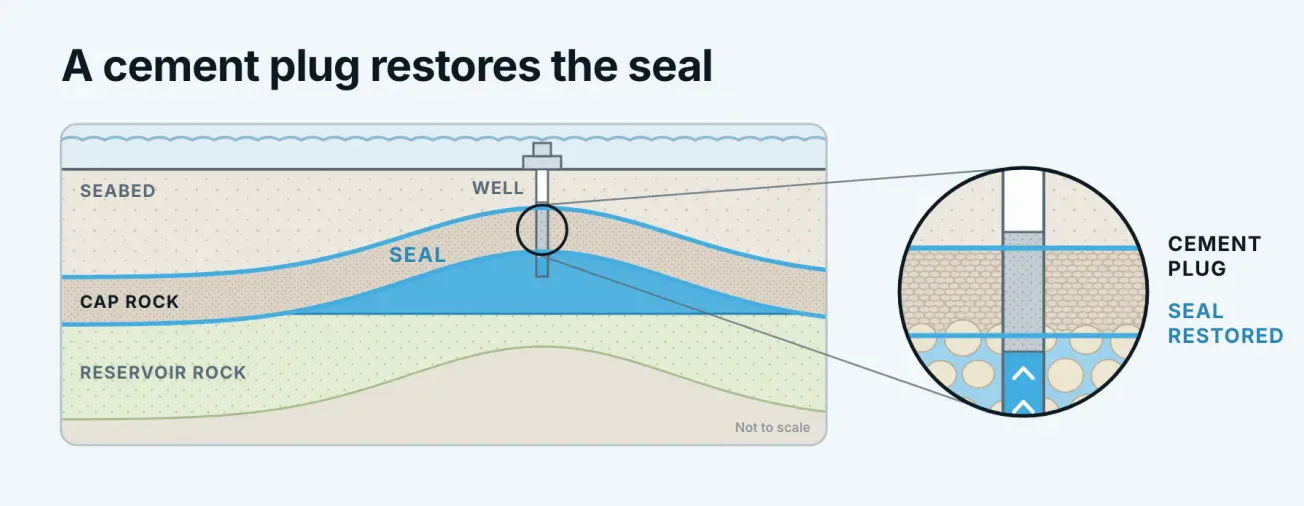
Oil, gas and water sit under pressure in porous reservoir rock, because of the huge volume of rock above. A fine-grained cap rock above the reservoir acts as a seal. When a well is abandoned, barriers, usually of cement, are placed in the well to restore that seal.
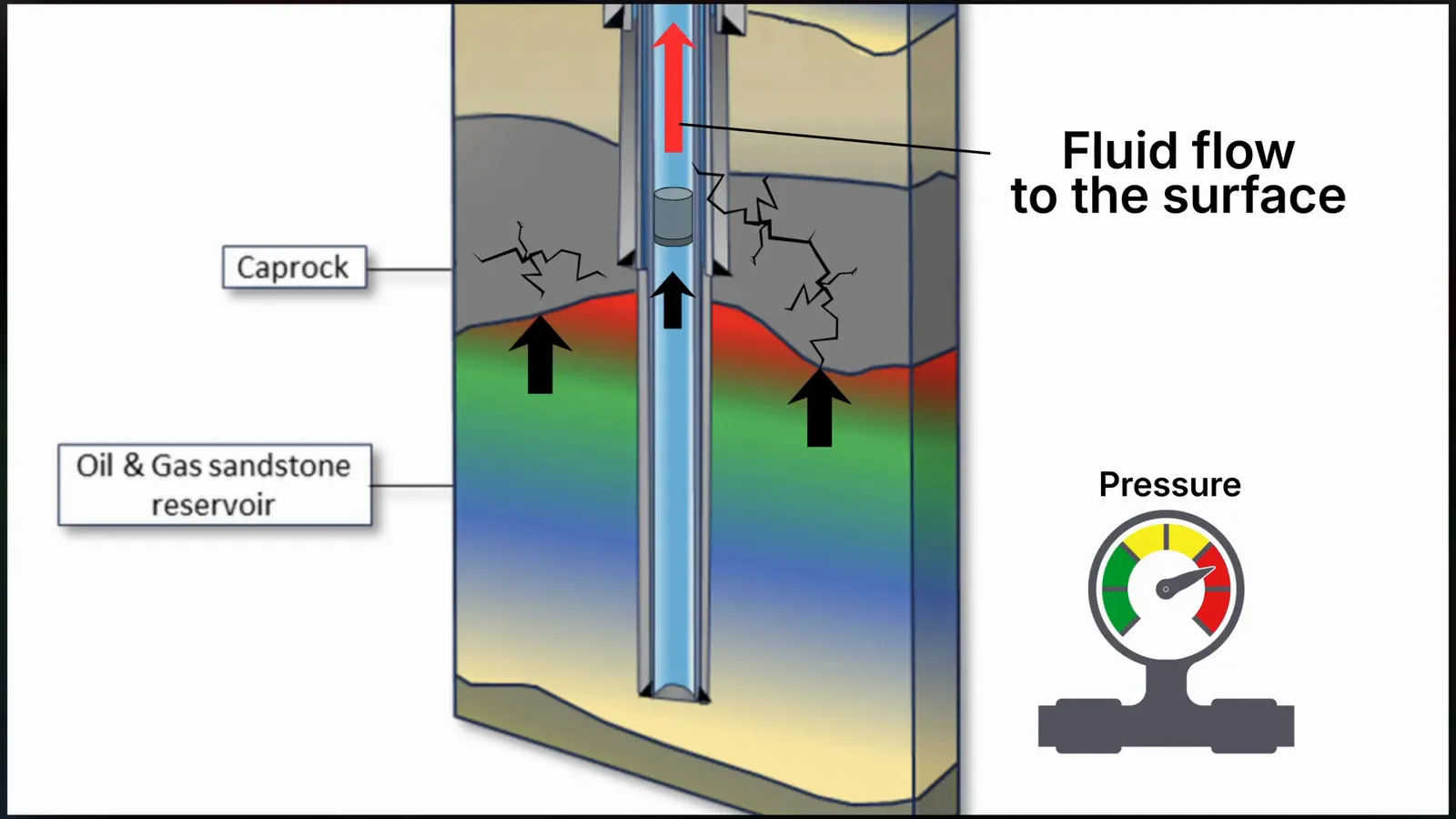
A barrier is only effective if the cap rock at the depth of the barrier can withstand the pressure from the reservoir fluids. If the cap rock at that depth is not strong enough, the rock can fracture and fluids can flow to the surface.
The MSAD marks the shallowest depth at which the cap rock can still withstand the pressure from the reservoir fluids. Above the MSAD, the cap rock is unsuitable for a barrier against that zone.
Formation breakdown is the point at which the pressure from the fluids is greater than the rock can withstand, so the rock fractures. A barrier set where the formation would break down is ineffective.
Where MSAD fits in the subsurface basis of design
- Analyse the data and the data gaps.
- Identify the permeable zones and the cap rocks.
- Evaluate pore pressure and fracture gradient.
- Find the minimum safe abandonment depth.
- Identify the isolation windows.
- Identify risks and opportunities.
- Agree the well abandonment strategy.
The subsurface basis of design for abandonment, as taught in the Lean Decom training. The MSAD is a key output of the study.
How does pressure change with depth?
Pressure generally increases with depth. The MSAD comes from comparing the pressure of the fluids with the strength of the rock at each depth.
Generally, the first 500 m of sediment drilled is very soft and unconsolidated. Deeper in the well, the pressures keep increasing.
Fluids in the rock are under pressure because of the volume of rock above. As depth increases, the pore pressure generally increases too. When a well is abandoned, barriers are placed against competent cap rock. If the pressure is too high for the cap rock, there is a risk of fracturing the cap rock, and of fluid flow to the surface.
| Term | Meaning, as defined in the training |
|---|---|
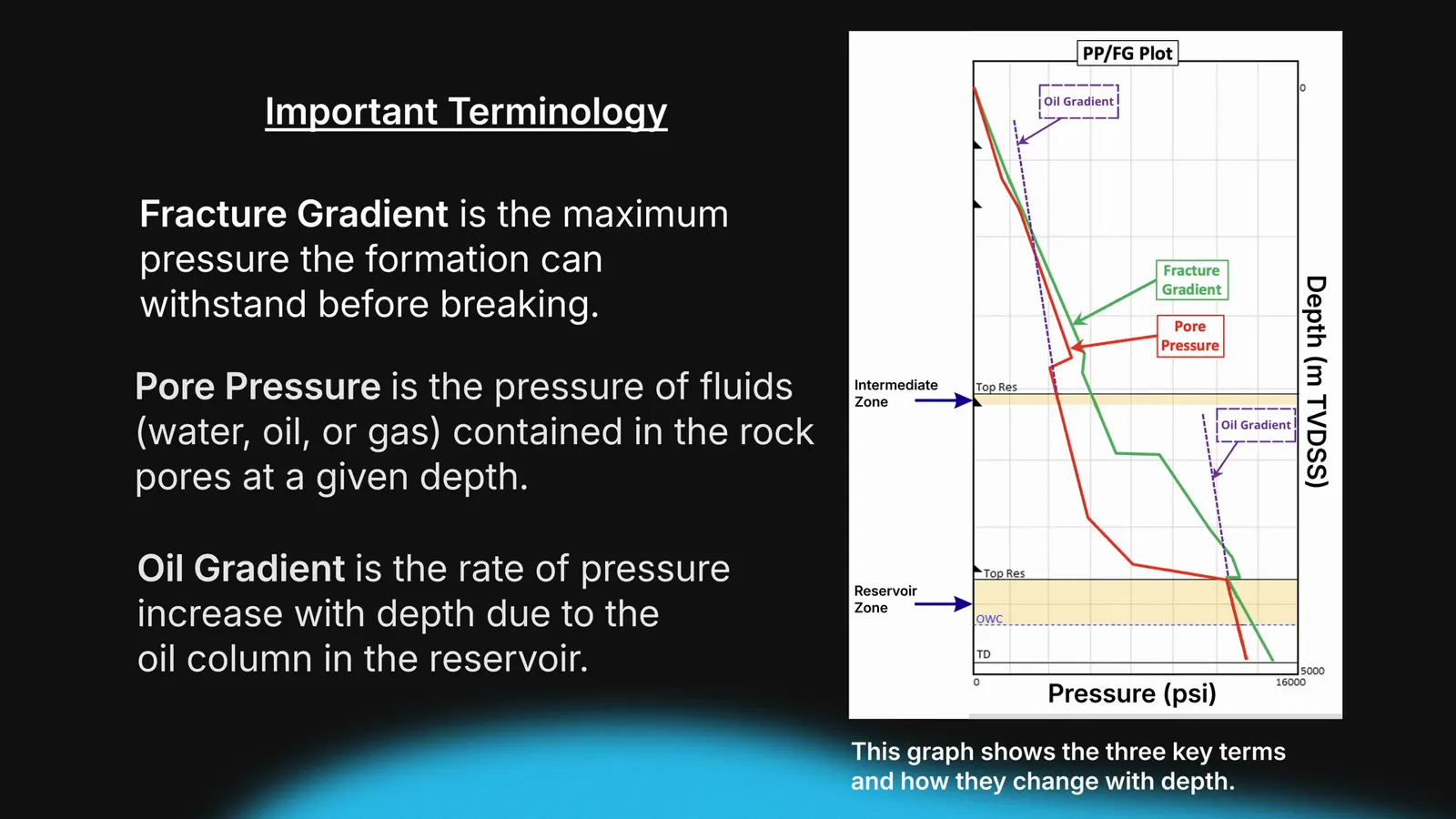
| Pore pressure | The pressure of the fluids (water, oil or gas) in the rock pores at a given depth. |
| Fracture gradient | The maximum pressure the formation can withstand before breaking. |
| Formation breakdown pressure | The pressure at which the formation breaks down and the rock fractures. |
| Fluid gradient | The rate of pressure increase with depth due to a column of fluid, such as the oil column in a reservoir. |
| Overburden pressure | The pressure from the rocks on top of the reservoir. |
What is a PP/FG plot in an MSAD calculation?
PP/FG stands for pore pressure and fracture gradient. A PP/FG plot shows the pressures in the rocks against the strength of the rocks, at each depth in the well. The MSAD is read from a PP/FG plot.
In the example in the training, depth is on the vertical axis in metres true vertical depth subsea (TVDSS), and pressure is on the horizontal axis in psi.
Pore pressure and fracture gradient prediction is familiar from drilling wells. For abandonment, the pressure evaluation also covers what may have changed over time with the production of the reservoirs.
The example plot in the training marks the data behind the lines: formation integrity tests (FIT), leak-off tests (LOT), repeat formation tests (RFT), drill stem tests (DST) and gas readings while drilling.
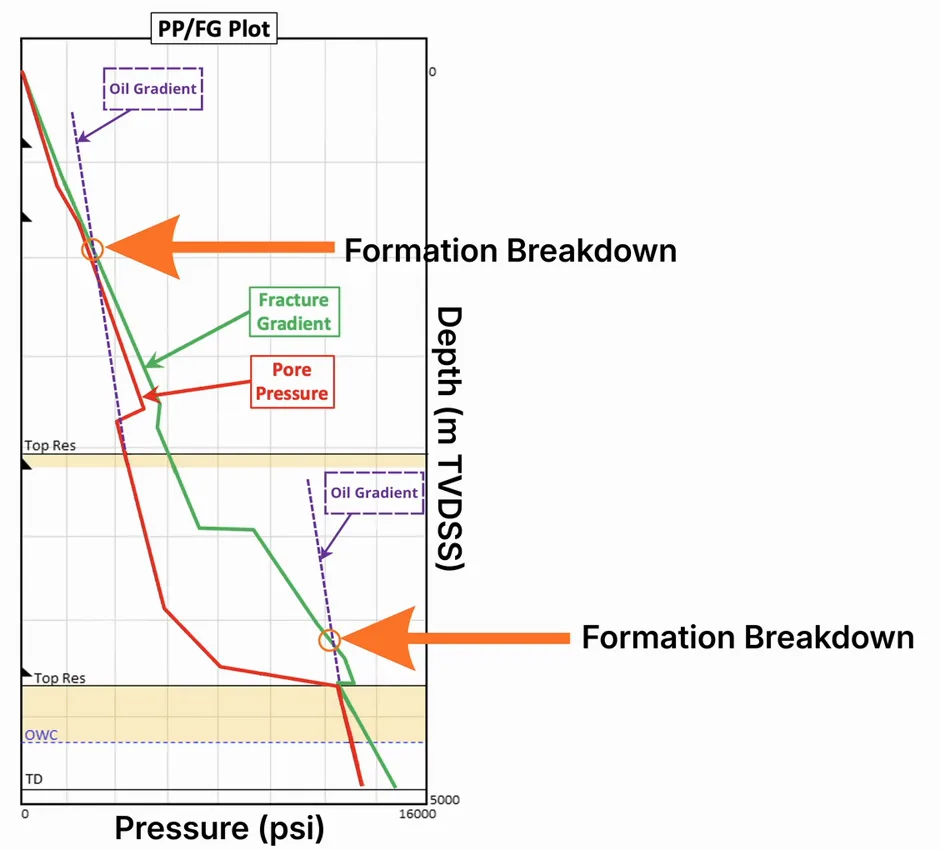
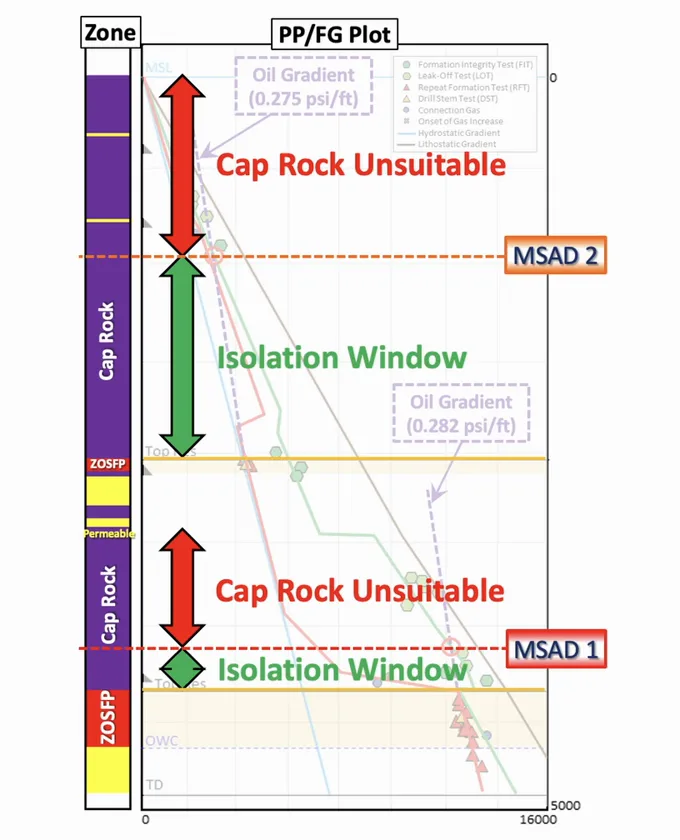
On the example plot, a dashed oil gradient line rises from each zone. Where the oil gradient line meets the fracture gradient, the formation breaks down. That crossing point sets the MSAD for the zone.
How is the minimum safe abandonment depth calculated?
The MSAD is found graphically, on a plot of pressure against depth. The steps below follow the method shown in the training for a CO2 store. The oil well example in the training uses the same construction, with an oil gradient and the fracture gradient line. The steps below are example steps, shown on example graphs.
Build the pressure and depth plot
Plot pressure against depth. Add the formation breakdown pressure: the pressure at which the rock fractures at each depth.
Mark the reservoir pressure
Mark the pressure of the zone being isolated. For a CO2 store, use the maximum reservoir pressure.
Choose the fluid gradient
Use the gradient of the fluid in the zone. For a CO2 store, the fluid is the CO2 being injected, so the gradient is a CO2 gradient.
Find the crossing point
Find where the fluid gradient line reaches the formation breakdown pressure.
Read across to the depth axis
That depth is the MSAD. The plugs are set below the MSAD.
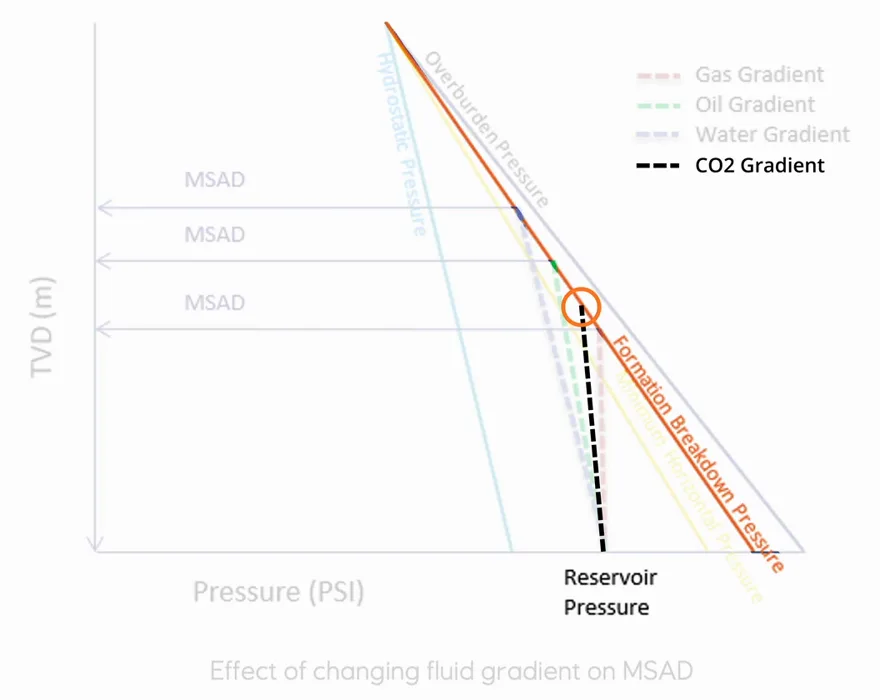
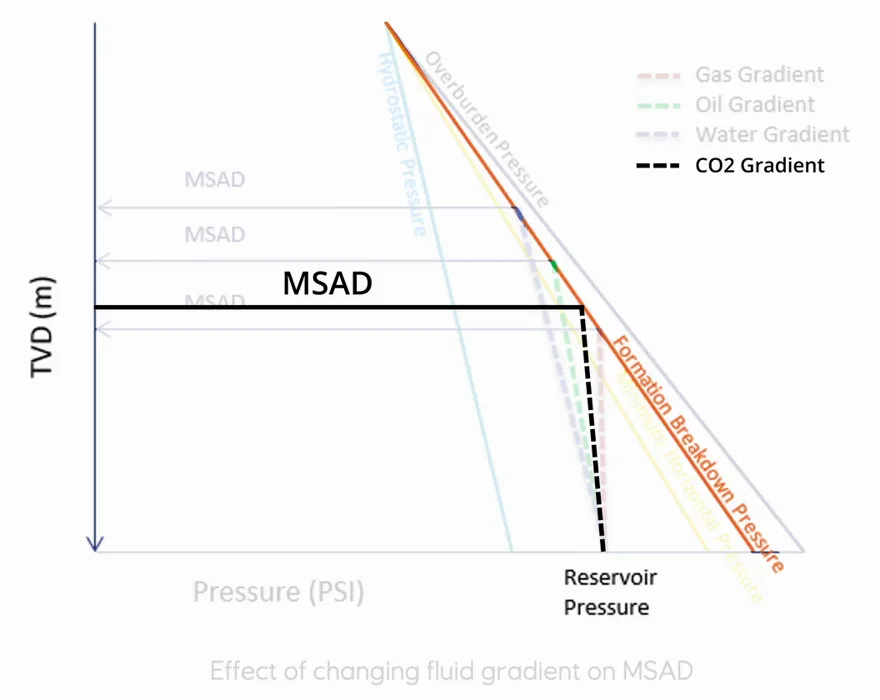
The MSAD is the depth at which a column of the reservoir fluid, starting from the reservoir pressure, reaches the formation breakdown pressure. Above that depth, the fluid pressure would be greater than the rock can withstand.
What is an isolation window, and can a well have more than one MSAD?
The MSAD is critical in understanding the isolation windows available for abandonment barriers. In the example in the training, a well with two zones of sustained flow potential has two MSADs.
The example plot in the training has two zones of sustained flow potential. The reservoir at the bottom of the well has MSAD 1, and an intermediate zone higher up has MSAD 2. Each zone has a separate oil gradient line, and so a separate MSAD.
On the plot, the cap rock above each MSAD is marked as unsuitable. The cap rock between the MSAD and the top of the zone below is the isolation window: the interval where the barriers for that zone can be set.
Inside the window, the barrier still needs casing that is not deformed or corroded, and good-quality annular cement.
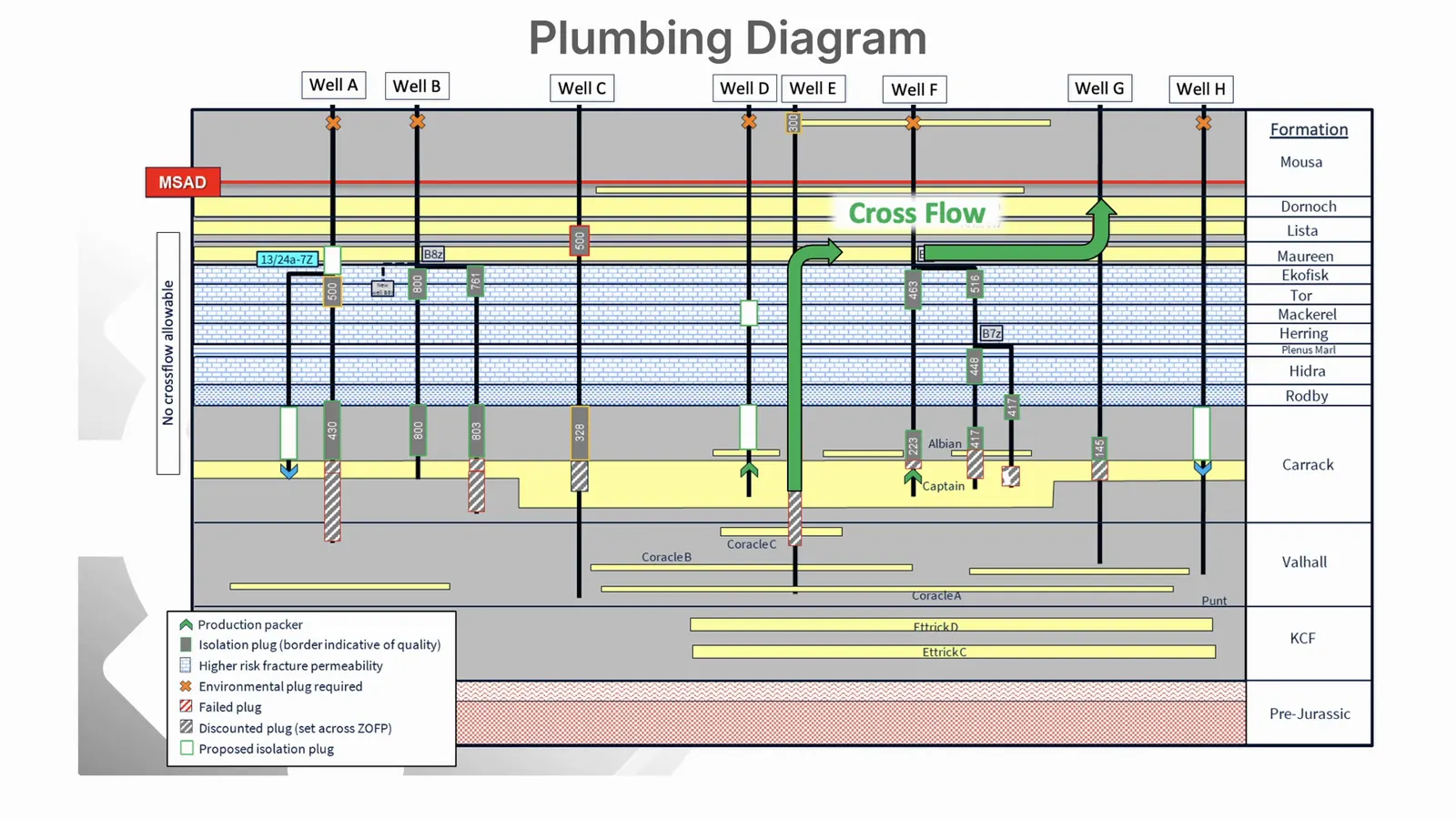
The isolation windows feed the zonal isolation philosophy: how the zones communicate, the likely cross flow between them, and where barriers will have good integrity.
How does CO2 storage change the MSAD?
A reservoir abandoned today may be used to store CO2 in future. CO2 injection may change both the pressure and the contents of the zones being abandoned now, so the MSAD is also calculated for CO2.
CO2 is stored as a dense fluid in the supercritical state, which CO2 reaches at approx. 800 m depth or greater. The CO2 must go into formations deep enough to contain the pressure. If CO2 is injected into a formation that is too shallow, the CO2 could fracture the formation and form a leak path into the overburden, or up to the seabed.
For a CO2 store, the MSAD is calculated with a CO2 gradient, starting from the maximum reservoir pressure. If the plugs are below that MSAD, the plugs are suitable for CO2 injection.
How the fluid gradient moves the MSAD
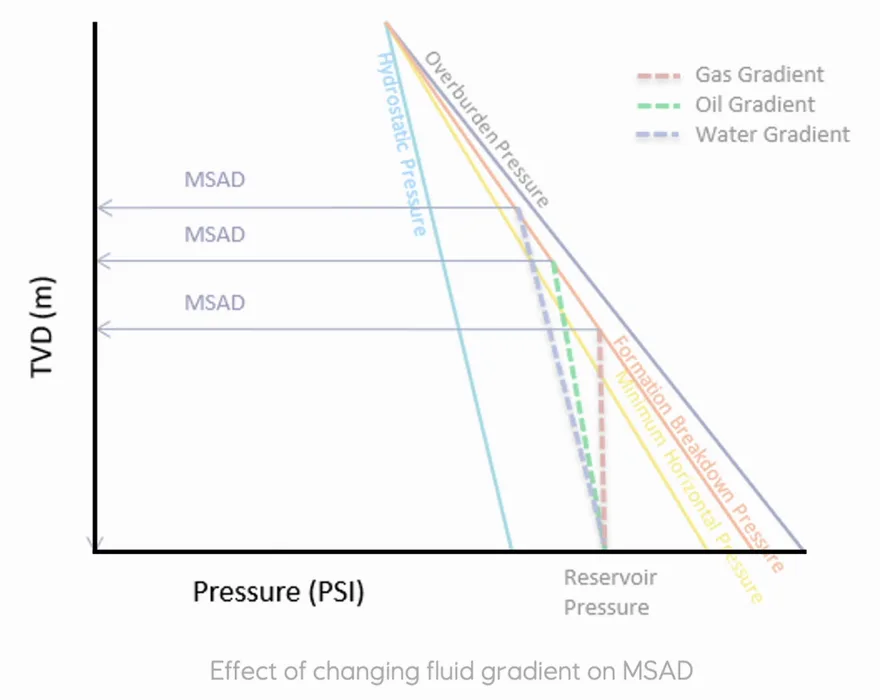
A slide in the training shows gas, oil and water gradients drawn from the same reservoir pressure. The gas line meets the formation breakdown pressure deepest, the oil line shallower and the water line shallowest. A lighter fluid loses less pressure up the column, so the lighter the fluid, the deeper the MSAD.
On the same slide, the CO2 line gives an MSAD deeper than the oil and water lines, and shallower than the gas line. The MSAD is calculated for wells that will be plugged and abandoned in future, and is also considered for old legacy wells in the field. See carbon capture and storage (CCS) considerations for well plug and abandonment.
Get your information pack
Course details and free sample lessons, emailed to you.
What makes the MSAD hard to define?
The MSAD depends on the data behind the PP/FG plot. Very little data is acquired across the overburden when a well is drilled.
Little data above the reservoir
The overburden is often treated as an inconvenience on the way to the reservoir. Gamma ray logs, cuttings and gas monitoring, perhaps from 500 ft, may be all there is. A full suite of logs is often run only across the reservoir. The cap rock available for barriers may be less than first assumed.
Pressures change over time
Years of production change the pressures in the reservoir. The pressure evaluation for abandonment covers what has changed since the well was drilled, and any plan for future CO2 injection.
Late life is the last opportunity
Late-life well interventions are the last time the wells can be entered to gather data. Pressure points, fluid samples or logs gathered then can reduce the subsurface risk, and with the risk, the abandonment cost.
Why the data is worth the cost
Late-life data is hard to justify, because the wells produce little by then and the work is a cost. But proving which zones have sustained flow potential, and where the MSAD and the isolation windows sit, decides how many barriers a well needs, and so which rig or vessel the work needs.
Ruling zones out can shift an abandonment cost from many millions of pounds to one or two million. The earlier the subsurface work starts, the easier and lower cost the execution will be.
MSAD in the Lean Decom training
Two modules cover the minimum safe abandonment depth: one from the subsurface side of well abandonment, and one from the CO2 storage side. Both are taught by specialists who do the work, online and video-based.
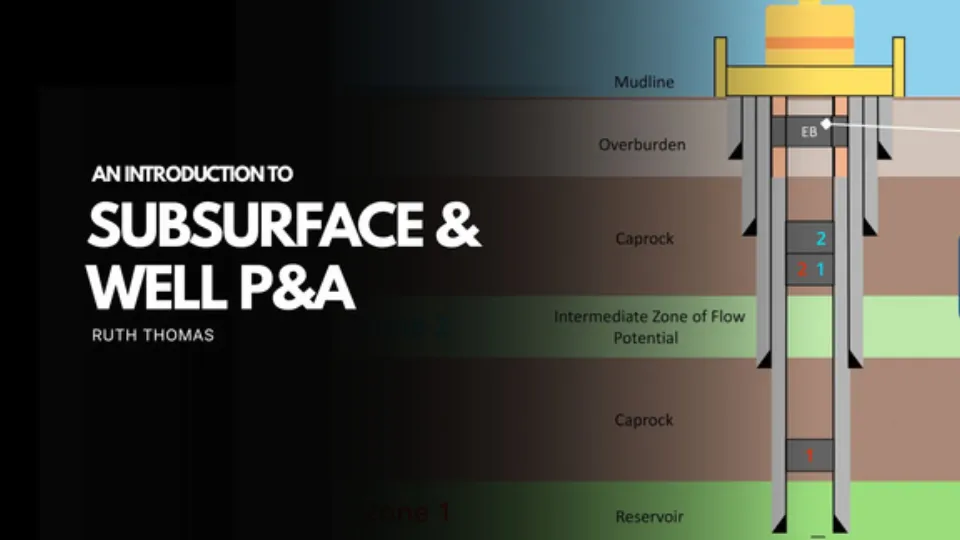
Subsurface and Well P&A
PP/FG plots, the MSAD, isolation windows and the subsurface basis of design for abandonment.

CCS Considerations in Well P&A
How to calculate the MSAD for CO2, and why legacy wells and good records matter for future storage.
MSAD terms
- Minimum safe abandonment depth (MSAD)
- The depth above which the cap rock is not strong enough to withstand the pressure exerted by the reservoir fluids.
- PP/FG plot
- A plot of pore pressure and fracture gradient against depth. The MSAD is read from the plot.
- Pore pressure
- The pressure of the fluids (water, oil or gas) in the rock pores at a given depth.
- Fracture gradient
- The maximum pressure a formation can withstand before breaking, as defined in the training.
- Formation breakdown pressure
- The pressure at which the formation breaks down and the rock fractures.
- Fluid gradient
- The rate of pressure change with depth in a column of fluid, such as oil, gas, water or CO2.
- Isolation window
- The interval of suitable cap rock below the MSAD and above the zone, where the barriers for that zone can be set.
- TVDSS
- True vertical depth subsea: vertical depth measured from sea level.
Sources and further reading
- Lean Decom training: Subsurface and Well P&A module, taught by Ruth Thomas, Well-Safe Solutions.
- Lean Decom training: CCS Considerations in Well P&A module, taught by Emma Dawson, Equinor.
- Intergovernmental Panel on Climate Change (IPCC): Special Report on Carbon Dioxide Capture and Storage, 2005, chapter 5. ipcc.ch
- NSTA: Legacy Wells and Carbon Storage: a UK perspective, lessons learned and best practice. Presentation, November 2025. sodir.no
MSAD: common questions
What does MSAD stand for?
MSAD stands for minimum safe abandonment depth. In well plug and abandonment, the MSAD is the depth above which the cap rock is not strong enough to withstand the pressure from the reservoir fluids.
Why must abandonment barriers be set below the MSAD?
Above the MSAD, the cap rock is not strong enough to withstand the pressure from the reservoir fluids. The formation would break down, fluids could flow to the surface, and the barrier would be ineffective. Below the MSAD, the cap rock can withstand the pressure.
How is MSAD calculated?
The MSAD is found on a plot of pressure against depth. Start at the reservoir pressure, extend the fluid gradient line (oil, gas, water or CO2) upwards, and find where the line meets the formation breakdown pressure. Reading across to the depth axis gives the MSAD.
What does PPFG mean in an MSAD calculation?
PPFG, or PP/FG, stands for pore pressure and fracture gradient. A PP/FG plot shows the pressures in the rocks against the strength of the rocks at each depth. In the example in the training, the MSAD is where the oil gradient line from a zone meets the fracture gradient on the plot.
Can a well have more than one MSAD?
Yes. In the example in the training, a well with two zones of sustained flow potential, the reservoir and an intermediate zone, has two MSADs. Each MSAD has an isolation window of suitable cap rock below.
Does CO2 storage change the MSAD?
Yes. For a CO2 store, the MSAD is calculated with a CO2 gradient from the maximum reservoir pressure. Plugs set below that MSAD are suitable for CO2 injection. In the illustration in the training, the MSAD for CO2 is deeper than the MSAD for oil or water.
Related topics

Get your information pack
Course details and free sample lessons, emailed to you.
Learn the subsurface side of well abandonment from the specialists
Lean Decom is a specialist decommissioning training provider. The training shares lessons from North Sea projects, taught by 18 specialists, for you to apply to your own work.