
KNOWLEDGE HUB
Well Plug and Abandonment (P&A) and Subsurface Strategy
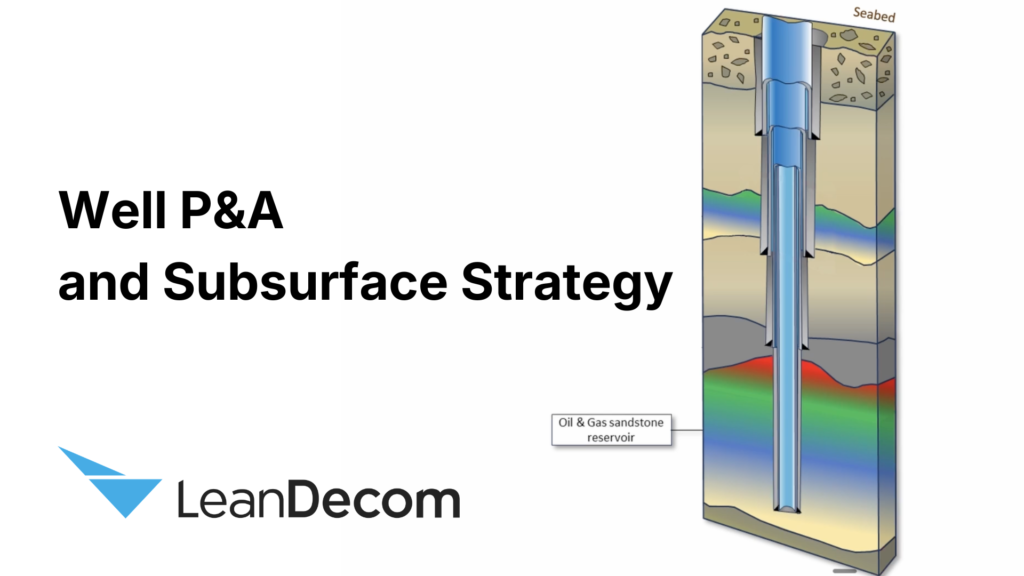
Well decommissioning, commonly referred to as Plug and Abandonment (P&A), represents the single largest financial commitment in the offshore asset lifecycle, historically accounting for approximately 50% of total decommissioning expenditure.
The ultimate objective is to permanently isolate subsurface fluids and restore the natural integrity of the caprock, ensuring long-term environmental containment and eliminating any potential leak pathways to the seabed.
The Subsurface Basis of Design for Abandonment (SSBOD)
Successful P&A begins years before a rig mobilises to the well. The foundation of the entire operation is the Subsurface Basis of Design for Abandonment (SSBOD).
The SSBOD defines:
- What must be isolated
- Where isolation barriers must be placed
- Why those barriers are required
Where drilling focuses on finding barrel adding opportunities, abandonment requires a fundamentally different mindset. The objective shifts from production growth to risk reduction and cost optimisation.
By accurately quantifying subsurface conditions, operators can often demonstrate that certain plugs are not required. This can reduce costs from several million pounds per well to significantly lower figures, without compromising integrity.
Key Subsurface Design Considerations
Three critical technical metrics drive abandonment design:
1. Sustained Flow Potential
Engineers and geoscientists must determine whether a formation has both:
- Sufficient pressure to drive flow
- Adequate permeability to transmit fluids
If a zone cannot sustain flow to surface, the requirement for an abandonment plug may be removed.
2. Minimum Safe Abandonment Depth (MSAD)
MSAD defines the shallowest depth at which a permanent barrier can safely be placed.
Above this depth, the caprock may not have sufficient strength to withstand reservoir pressure. Setting a plug too shallow could fracture the formation and create a leak pathway to the seabed.
3. Pore Pressure and Fracture Gradient
A clear understanding of:
- The pressure exerted by fluids within the rock (pore pressure)
- The strength of the surrounding formation (fracture gradient)
is essential. Barriers must be set against competent formations capable of withstanding long term pressure without mechanical breakdown.
Engineering Execution: AB1, AB2 and AB3
Physical well abandonment is typically executed in three defined stages.
AB1 – Reservoir Isolation
- Production infrastructure, including completions and packers, is removed
- A permanent double barrier is installed above the reservoir
- This is the primary seal and is designed to restore caprock integrity
AB2 – Intermediate Zone Isolation
- Secondary hydrocarbon zones
- Over-pressured water zones in the overburden
- Where required, additional double barriers are installed to isolate these intervals
AB3 – Wellhead Recovery
- Internal casings and conductors are severed
- Typically three metres (10 feet) below the mud line
- The wellhead is recovered to surface
Once the wellhead has been removed and barriers verified, the well is considered permanently abandoned.
Barrier Philosophy and Verification
Cement remains the industry standard for permanent isolation due to its well-understood response to pressure and temperature over time.
For hydrocarbon bearing zones, regulatory requirements typically mandate:
- Two independent 100 foot verified cement barriers, or
- One verified 200 foot combination plug
Barrier Verification
Installation alone is not sufficient. Barriers must be verified.
The objective is a true rock-to-rock seal that prevents fluid migration behind casing.
Strategic Efficiency: Breaking the Silos
The most effective way to manage P&A cost is through early, interdisciplinary collaboration.
- Alternative barrier strategies
- Plan B and Plan C contingencies
- Reduced rig time risk
- Data driven decision making
Learn More on Lean Decom
Our training course covers well plug and abandonment strategy in detail, including subsurface design, barrier philosophy, and cost optimisation techniques. Learn more on the training course page.